flowchart LR
  A[10 ng DNA] --> B[Bisulfite<br/>conversion]
  B --> C[Column<br/>cleanup]
  C --> D[PrepAmp<br/>random priming]
  D --> E[DCC]
  E --> F[Amp 1<br/>8 cycles]
  F --> G[DCC]
  G --> H[Amp 2 + UDI index<br/>10 cycles]
  H --> I[1× bead<br/>cleanup]
  I --> J[(Qubit +<br/>TapeStation)]
WGBS library prep (Zymo Pico Methyl-Seq)
DNA methylation
Porites astreoides
Bisulfite-convert 10 ng of coral genomic DNA and build indexed whole-genome bisulfite sequencing libraries with the Zymo Pico Methyl-Seq kit, with QC and a re-amplification rescue.
At a glance
| Input | 10 ng genomic DNA (1 ng µL⁻¹ in 10 mM Tris-HCl) |
| Output | Dual-indexed WGBS library, ~15 µL, QC’d by Qubit and D5000 TapeStation |
| Kit | Zymo Pico Methyl-Seq Library Prep Kit + KAPA Pure Beads |
| Time | 1.5 days: dilution + conversion in the afternoon (overnight stop), then cleanup through QC the next day |
| Tested on | Porites astreoides adults and larvae |
This is an adapted workflow, not a replacement for the kit manual. Follow the Zymo Pico Methyl-Seq manual for the full reagent details. The changes from the manual are 10 ng input (instead of 1 ng) with fewer amplification cycles, and a diluted polymerase so you never pipette 0.3 µL.
Materials
- Zymo Pico Methyl-Seq Library Prep Kit; KAPA Pure Beads (Roche)
- Unique dual index (UDI) i5/i7 primers, 10 µM. Plan the pairs before you start (see Before you start)
- 10 mM Tris-HCl pH 8.0; 100% ethanol (fresh 80% each day); ultrapure water
- Thermocycler, thermomixer (56 °C), microcentrifuge (16,000 × g), magnetic plate for PCR strips, tube rotator/shaker
- PCR strip tubes, 1.5 mL tubes, filter tips
- Qubit dsDNA BR assay; Agilent TapeStation with D5000 ScreenTape and reagents
Before you start
- Dilute DNA to 1 ng µL⁻¹ in 10 mM Tris-HCl. Calculate all dilutions ahead of time.
- Plan indexes: every library gets a unique i5 and a unique i7. Don’t reuse an index number within a pool, even in a different pairing (this limits index hopping). Putnam Lab UDI list: UDI index primer pairs.
- Thermocycler programs to save: BS conversion, PrepAmp priming, Amp 1 and Amp 2 (cycle numbers below).
- Work out n = number of samples + ~5% for every master mix.
- While each step runs, prepare the master mixes for the next step on ice.
Procedure
Day 1: Bisulfite conversion
- In PCR strips: 10 µL DNA (10 ng) + 10 µL 10 mM Tris-HCl = 20 µL.
- Add 130 µL Lightning Conversion Reagent (150 µL total). Vortex and spin down.
- Run: 98 °C 8 min → 54 °C 60 min → 4 °C hold (~1.5 h).
Tip⏸ Safe stopping point
Converted DNA is stable at 4 °C for up to 20 h. Stop here overnight.
Day 2
Post-conversion column cleanup
- Add 600 µL M-Binding Buffer to a spin column, then the whole 150 µL conversion. Cap, invert 5–10×, spin 30 s. Discard flow-through into the kit’s hazardous-waste container.
- 100 µL M-Wash, spin 30 s.
- 200 µL L-Desulphonation Buffer, stand 15 min at room temp, spin 30 s. Meanwhile warm the DNA Elution Buffer to 56 °C.
- 200 µL M-Wash, spin 30 s. Repeat, spinning 2 min the second time.
- Move the column to a 1.5 mL tube. Add 8 µL warm Elution Buffer to the membrane, wait 5 min, spin 30 s. Keep on ice and check all tubes have the same volume.
PrepAmp (random priming)
Master mixes (× n), on ice:
Mix Per sample PMM (priming) 2 µL 5× PrepAmp Buffer + 1 µL 40 µM PrepAmp Primer PAMM (PrepAmp) 1 µL 5× PrepAmp Buffer + 3.75 µL PrepAmp Pre-mix + 0.3 µL PrepAmp Polymerase Diluted polymerase 0.3 µL PrepAmp Polymerase + 0.2 µL Elution Buffer (so you add 0.5 µL) 7 µL converted DNA + 3 µL PMM in new strips. Vortex, spin, and start the priming program:
Step Temp / time Denature 98 °C 2 min → 8 °C 1 min → 8 °C hold ① At the hold Take tubes out, vortex/spin, add 5.05 µL PAMM, vortex/spin, return and continue Priming 8 °C 4 min, then 16, 22, 28, 36, 36.5 °C for 1 min each (3% ramp), 37 °C 8 min Repeat Denature → hold again ② At the hold Add 0.5 µL diluted polymerase, vortex/spin, continue the priming steps
DNA Clean & Concentrator (DCC) 1
- Add the whole priming reaction (~15.5 µL) to 108.85 µL DNA Binding Buffer (7:1), vortex, load a spin column, spin 30 s.
- 200 µL DNA Wash, spin 30 s; repeat with a 2 min spin.
- Elute in 12 µL warm Elution Buffer (5 min, spin 30 s).
Amplification 1
- Per sample: 12.5 µL 2× Library Amp Mix + 1 µL 10 µM Library Amp Primers (13.5 µL) + 11.5 µL DCC eluate.
- Run Amp 1 with 8 cycles for 10 ng input (10 cycles for 1 ng) (~30 min).
DCC 2
- 25 µL reaction + 175 µL DNA Binding Buffer (7:1). Bind, wash 2× as above, elute in 12.5 µL warm Elution Buffer.
Amplification 2 (indexing)
- Per sample: 12 µL DNA + 14 µL 2× Library Amp Mix + 1 µL i5 + 1 µL i7 (10 µM). Tick each addition off on a sheet as you go.
- Run Amp 2 with 10 cycles for 10 ng input (12 for 1 ng) (~30 min). Take the KAPA beads out of the fridge now.
1× bead cleanup
- Beads at room temp (≥ 30 min), swirled not vortexed. Make fresh 80% ethanol.
- Add 26 µL beads (1×) to each library. Pipette-mix ≥ 10× and rotate 15 min at 200 rpm.
- On the magnet, wait until clear, then remove the supernatant.
- Wash 2× with 200 µL 80% ethanol without disturbing the beads. Remove all residual liquid with a P20 and air-dry ~1 min.
- Off the magnet, resuspend in 15 µL Elution Buffer, shake 5 min at 200 rpm, return to the magnet and transfer the clear eluate to labeled final tubes (sample, date, “lib”, initials).
Tip⏸ Safe stopping point
Libraries can go to −20 °C here if you’re not doing QC the same day.
QC and expected results
| Check | Method | Good result |
|---|---|---|
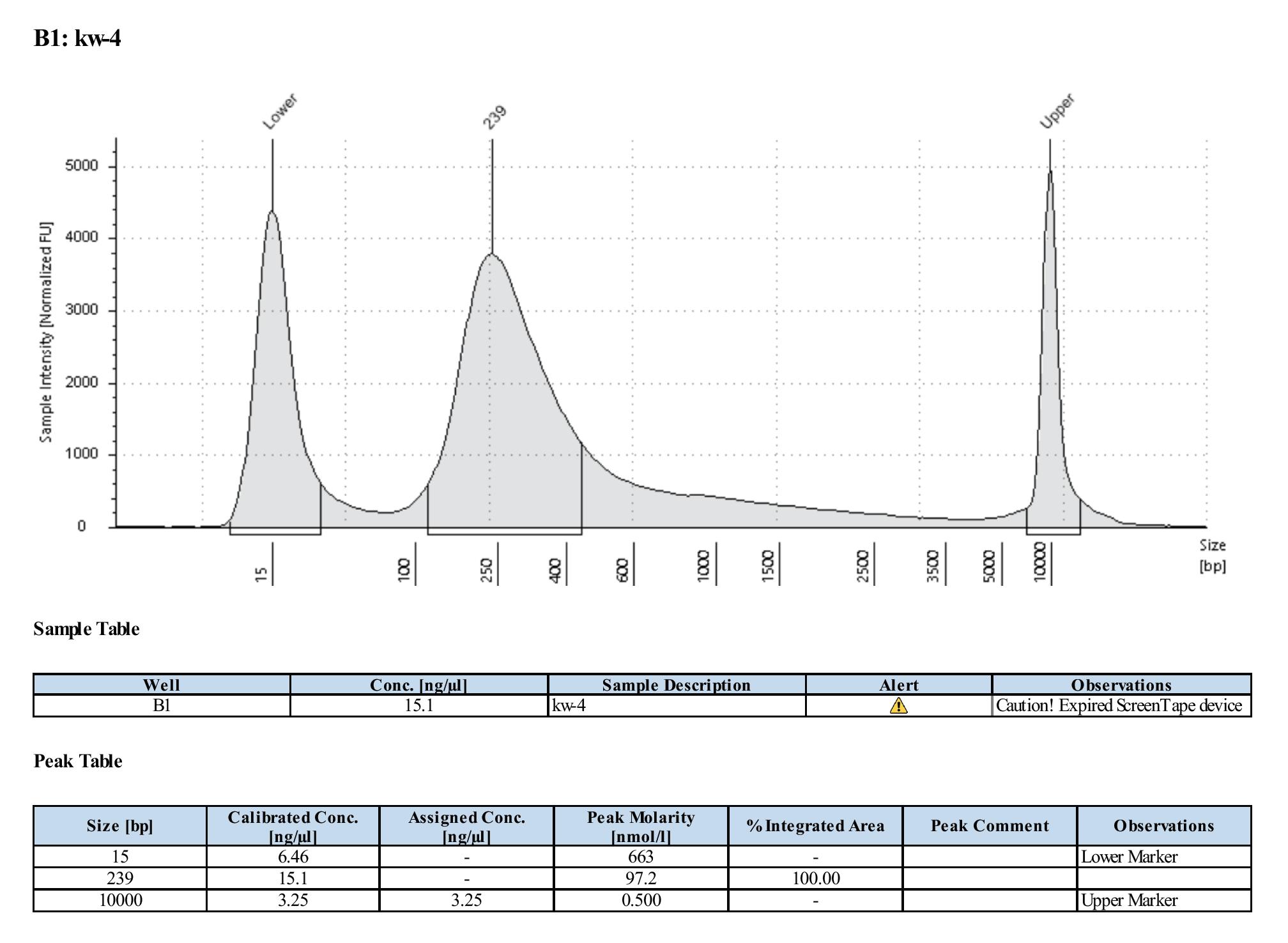
| Concentration | Qubit dsDNA BR, read twice and average | > 5 ng µL⁻¹ (re-amplify below that, see below) |
| Size | D5000 TapeStation | Smooth peak in the same range as the other libraries; no library with a very different size profile |
In the Thermal Transplant preps, libraries came out at about 3–22 ng µL⁻¹. An example of a good trace that was sequenced:
Rescue: re-amplify low-yield libraries (< 5 ng µL⁻¹)
Repeat Amp 2 + bead cleanup with 4 cycles: 12 µL library + 13 µL 2× Library Amp Mix + 1 µL combined i5/i7 (the same indexes as before), then a 1× bead cleanup. In 2021 this brought most low libraries to 7–27 ng µL⁻¹. A few libraries that read “too low” stayed too low and need to be re-prepped from DNA.
Troubleshooting
| Problem | Likely cause | Fix |
|---|---|---|
| Library fails (Qubit “too low”) | Unequal elution after conversion, or sample loss in the cleanups | Check volumes after step 8; elute slowly onto the membrane center |
| Less than 15.5 µL after priming | Evaporation (priming program has a low lid temperature) | Expected; transfer everything into the binding buffer |
| 0.3 µL polymerase doesn’t leave the tip | Volume too small | Use the diluted polymerase (0.5 µL) |
| Library yield < 5 ng µL⁻¹ | Low input or efficiency | Re-amplify with 4 cycles (above) |
References
- Zymo Research. Pico Methyl-Seq Library Prep Kit manual and video series
- Putnam Lab WGBS Pico Methyl-Seq protocol (M. Schedl, E. Strand), the basis for this version
- Qubit protocol, D5000 TapeStation protocol
- Analysis: DNA methylation central document
Notebook entries using this protocol
No matching items
Changelog
| Date | Version | Change |
|---|---|---|
| 2026-10-05 | 1.0 | Rewritten from the 2021 Thermal Transplant protocol and library-prep trials; re-amplification rescue added |
| 2021-05 | – | Re-amplification of low libraries (4 cycles) |
| 2021-04 | – | 10 ng input with reduced Amp 1/Amp 2 cycles; eight library-prep batches |